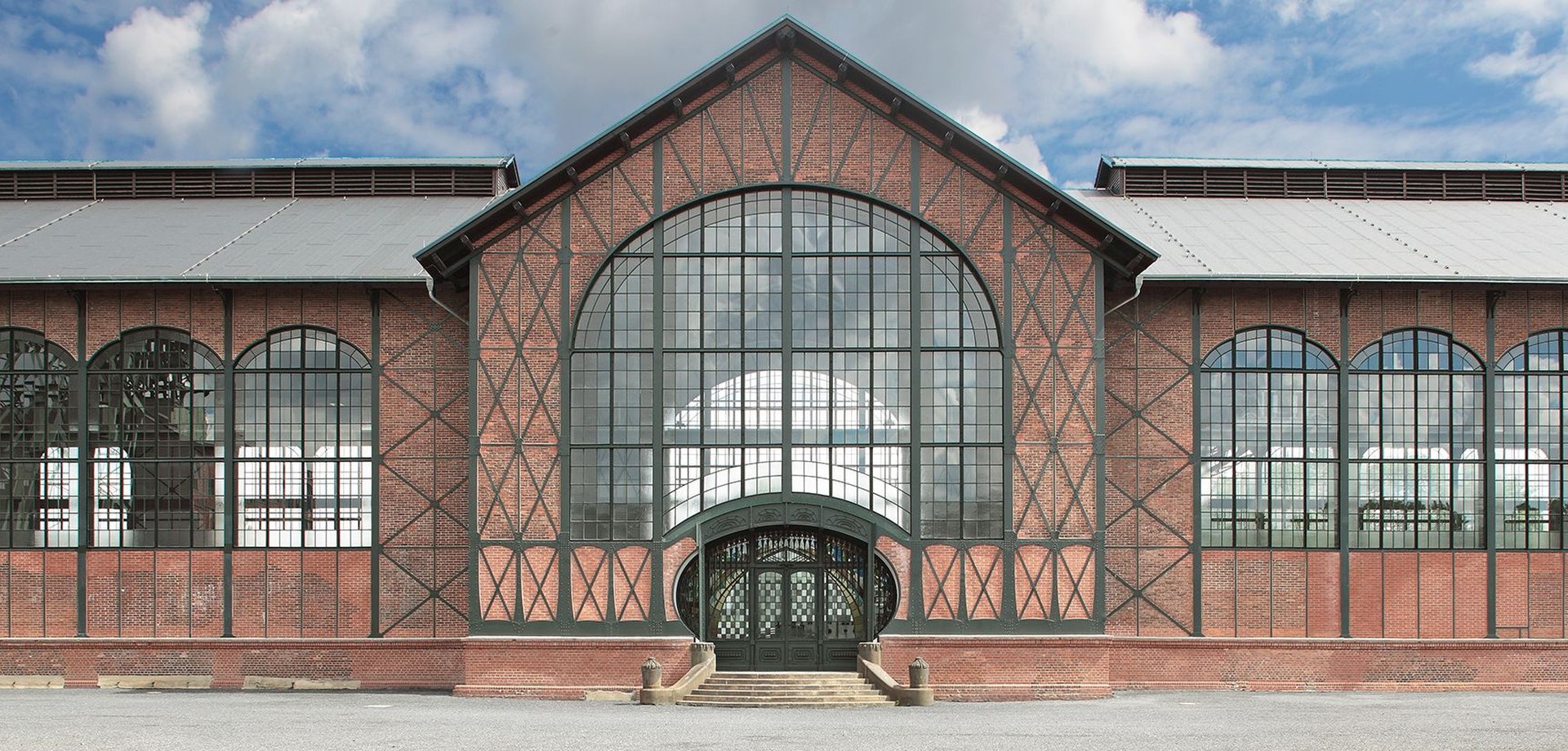
The machine hall at the Zollern Colliery showcases outstanding quality in many respects: built in 1902/1903 according to designs by Berlin architect Möhring, the steel truss structure represents the dawn of modern industrial architecture. Stylistically, it marks the transition from historicism and Art Nouveau to modernism. The preserved historical machinery – in particular the hoist engine – is one-of-a-kind in Germany. The hall is especially famous for its colour-glazed Art Nouveau portal. There is no other industrial building in Europe with a portal like this.
The machine hall also has great symbolic significance: when civic engagement saved the plant in 1969, it was the first facility of its kind to be placed under protection in Germany, thus establishing a new field of ‘industrial landmark preservation’. Last but not least, the machine hall also became the nucleus of the Westphalian Industrial Museum (today the LWL Museums of Industrial Heritage) and its eight locations. The machine hall thus represents the beginning of industrial heritage preservation and industrial culture.
3D tour (Eschenbach Media)
This offer is not barrier-free.
Switch to simple language.
Activate audio support.
A video will open up presenting the text in sign language.
By starting to play the video, you accept the privacy policy of YouTube.
A video will open up presenting the text in sign language.
The machine hall underwent extensive renovation between 2011 and 2016. The focus was on preserving the building with its diverse traces of use. Former museum director Dirk Zache explains the concept in the video (German).
A cookie is text information that the visited website places on the viewer’s (‘client’) computer through the web browser.
The cookie is either sent to the browser by the web server or generated by a script (possibly JavaScript) in the website.
The client sends the cookie information to the server again with every request on later new visits to this site.
To offer you a more pleasant experience, we use cookies to save your language settings, for example,
or to collect anonymous statistical data that we can use to optimise the user experience/ergonomics on our online services.
Listed below, you’ll see cookies divided into categories; you can select or deselect categories by using Opt-in.
These cookies and services are necessary for you to visit our online services and use their features.
Without them, you cannot use services, such as login (sessions), language settings,
shopping cart and privacy settings, as well as services related to security.
Except for login (sessions), no information of a sensitive nature that can be used to identify you will be collected.
Mandatory Cookies
These cookies are needed for normal functioning of the website.
django_language
Bestimmt die bevorzugte Sprache des Besuchers. Ermöglicht der Webseite, beim erneuten Besuch des Besuchers die bevorzugte Sprache festzulegen.
Lifetime: 1 Jahr
csrftoken
Hilft, Cross-Site Request Forgery- (CSRF-) Angriffe zu verhindern.
Lifetime: 1 Jahr
Facebook Pixel
These cookies and services collect information about how you use our online services,
such as which functions and pages you use most often. This data can help us optimise our online services,
for example, or simplify navigation. They are also used to inform partners whether you reached our
website through a partner site, and whether your visit led to using one of our offers; however,
no information will be recorded that can be used to personally identify you.
Statistics Cookies
These cookies are used for collecting usage statistics of the website.
_pk_ses*
Wird von Piwik Analytics Platform genutzt, um Seitenabrufe des Besuchers während der Sitzung nach zu verfolgen.
Lifetime: 1 Tag
Domain: https://piwik.lwl.org/piwik/piwik.js
_pk_ref.*
Speicherung der ID der Herkunftsseite (referrer ID)
Lifetime: 6 Monate
Domain: https://piwik.lwl.org/piwik/piwik.js
Youtube Videos
These cookies and services allow the usage of youtube videos on the website.
PREF
Dieses cookie speichert Ihre Präferenzen und andere Informationen, insbesondere bevorzugte Sprache, wie viele Suchergebnisse auf Ihrer Seite angezeigt werden sollen und ob Sie den SafeSearch-Filter von Google aktivieren möchten oder nicht.
Lifetime: 2 Jahre
Domain: .youtube.com
CONSENT
Lifetime: 6 MONATE
Domain: .youtube.com
VISITOR_INFO1_LIVE
Hierbei handelt es sich um ein Cookie, das YouTube setzt, um die Bandbreite des Nutzers zu berechnen.
Lifetime: 6 Monate
Domain: .youtube.com
YSC
Registriert eine eindeutige ID, um Statistiken der Videos von YouTube, die der Benutzer gesehen hat, zu behalten.